"All books are either dreams or swords,/You can cut, or you can drug, with words." - Amy Lowell, 'Sword Blades and Poppy Seed'
Showing posts with label novels. Show all posts

Monday, September 3, 2012

Feed

Grant, Mira. Feed. New York: Orbit, 2010. 608 pages
(I read it as an e-book)

Set about 26 years after the Rising, the book takes place in a world where zombies are certainly still dangerous, but they are also a fact of life.  Bloggers, such as Georgia and Shaun Mason, are serious journalists, and journalism requires weapons testing and licensing.  It's a recognizable yet irretrievably different world.  Blood test are as common as washing your hands, and Alaska has been lost to the undead. The entire world population is infected with Kellis-Amberlee, the unintentional hybrid of the cure for cancer and the cure for the common cold that raises the dead.  While covering presidential candidate Peter Ryman, Georgia, Shaun and their blogging team discover a political conspiracy involving people who are not afraid to use Kellis-Amberlee as a weapon.

Overall Rating: **** (out of five)

Strengths:
  • Rich Woldbuilding.  The world of the U.S. in 2040 is not only a believable projection of what our world would be like if we combined modern technology and society with a world where zombies are the norm, but it is described with a richness that makes it real.  Comments from the characters about life "pre-Rising" helps the reader understand just how drastically the zombies have changed many aspects of life that we would take for granted.
  • Plot.  In exploring a world that has reached a sense of equilibrium with zombies, rather than one suddenly hit by a zombie apocalypse, Grant has the freedom to write a book where zombies are integral to the plot without actually being the plot. For anyone who likes meaty political conspiracy thrillers, this is definitely a book for you.
  • Scientific Grounding.  Kellis-Amberlee, the hybrid virus that causes zombies, is extremely well created.  The basis of this book in virology, how viruses behave and spread, and how society might deal with worldwide epidemic, are excellently portrayed.
Weaknesses:
  • Characterizations.  At points during the book, some of the characters are just a bit flat and static.  This is not frequent, and is usually compensated for by the quality of the plot and the other characters.  This is mostly related to Senator Ryman, as he frankly seems too good to be true at times.  As this is a fact recognized by the other characters as well, it is clearly an intentional choice, and is easy enough to overlook.
Warnings: Extreme violence and profanity, both of which are understandable when confronting zombies, but an FYI that there's a lot of both.

Friday, August 5, 2011

Film Friday: Casino Royale

Fleming, Ian. Casino Royale. New York: Penguin, 1953.

"Introducing James Bond: charming, sophisticated, handsome; chillingly ruthless and licensed to kill. This, the first of Ian Fleming's tales of secret agent 007, finds Bond on a mission to neutralize a lethal, high-rolling Russian operative called simply "Le Chiffre"--by ruining him at the Baccarat table and forcing his Soviet spymasters to 'retire' him. It seems that lady luck is taken with 007--Le Chiffre has hit a losing streak. But some people just refuse to play by the rules, and Bond's attraction to a beautiful female agent leads him to disaster and an unexpected savior." (description from book cover)

Book Rating: *** (out of five)
Movie Rating: **** (out of five)

Strengths:
  • Plot. Fleming's inaugural James bond novel is certainly gripping.  Bombs, hit men, torture, gambling, sex. This book has it all, and the mixture is entertaining. Fleming's world of espionage is based backstabbing and double agents, and he knows just how far to go before it gets ridiculous.
  • Lack of Judgement. I like authors who present their characters on their own merits,without trying to force a ready-made definition of good or evil down the audiences' throats, and Fleming often succeeds at doing just that.
Weaknesses:
  • Dialogue. Fleming may be able to spin a yarn, but his characters could use some better self-expression.  It's not that it is overtly cliched, it simply seems stilted at times.
  • Sex and Violence. As I think most people know to expect, the book has plenty of, well, sex and violence. There are also less than flattering observations made of the women in the book, though the sexism is more tempered than I anticipated.

Wednesday, July 27, 2011

Children's/YA: The Witches

Dahl, Roald. The Witches. New York: Puffin, 1983. 208 pages.

"'A REAL WITCH is easily the most terrifying thing on earth.' That's a pretty thought. More horrifying still is that real witches don't even look like witches. They don't ride around on broomsticks. They don't even wear black cloaks and hats. They are vile, despicable, scheming harridans who disguise themselves as nice, ordinary ladies. So how can you tell when you're face to face with one? Read this story and you'll find out all you need to know. You'll meet a real hero, a wise old grandmother and the most gruesome, grotesque gang of witches imaginable!"

Overall Rating: **** (out of five)

Strengths:
  • Trustworthy Adult. The grandmother in this story is every child's dream authority figure.  She tells you all those deliciously scary stories that parents don't want children to hear.  She takes you on fun vacations.  And when your confrontations with witches go sour, she loves you anyway.  Who wouldn't want that?
  • Exciting Story. Let's face it, this book is a wonderful adventure story for children. It has a wonderful everyman hero and a whole cast of dastardly villains. If the boy was Harrison Ford and the witches were secretly Nazis, it could be an Indiana Jones movie. Well, almost. But it's that kind of black and white, unapologetic adventure tale, but for kids.
Weaknesses:
  • The Witches. The witches as described in the book, are fairly terrifying. Any child taking it seriously would be looking sideways at all women forever, looking for enlarged nostrils or toeless feet, or signs of a wig, or blue spit. While this doesn't seem to be a problem with most children, it is worth keeping in mind.

Monday, July 25, 2011

The Murder of Roger Ackroyd

Christie, Agatha. The Murder of Roger Ackroyd. New York: HarperCollins, 2011. 304 pages.

"Roger Ackroyd knew too much. He knew that the women he loved had poisoned her brutal first husband. He suspected also that someone had been blackmailing her. Then, tragically, came the news that she had taken her own life with a drug overdose. But the evening post brought Roger one last fatal scrap of information. Unfortunately, before he could finish reading the letter, he was stabbed to death." (description from book cover)

Overall Rating: *** (out of five)

Strengths:
  • Mystery. Christie's classic locker room mystery is well-constructed, not surprisingly.  The story provides all the clues to solving it, but the conclusion can still come as a surprise.  While people familiar with Christie's writing might know enough to assume that the obvious suspect may not be the right one, there are loose threads galore that complicate the solving of the mystery.
Weaknesses:
  • Plot.  Though the mystery is good, the surrounding plot is less than stellar.  It seems as though all of the actual story happens in the brief period before the murder and Poirot's arrival.  This sort of mystery that is focused more on clues than characters works better as a short story than requiring the development of a novel.  The mystery is compelling enough to over come this, however.
  • Characterization. The sub-par plot is compounded by the one-dimensionality of the characters.  Their tendency toward being one-note stereotypes rather than fully realized people can make the reader wonder why they should care about them. The mystery is compelling enough to over come this, however.

Wednesday, July 20, 2011

Children's/YA: The Phantom Tollbooth

Juster, Norton. The Phantom Tollbooth. New York: Bullseye Books, 1989. 256 pages.

"For Milo, everything's a bore. When a tollbooth mysteriously appears in his room, he drives through only because he's got nothing better to do. But on the other side, things seem different. Milo visits the island of conclusions (you get there by jumping), learns about time from a ticking watchdog named Tock, and , even embarks on a quest to rescue Rhyme and Reason! Somewhere along the way, Milo realizes something astonishing. Life is far from dull. In fact, it's exciting beyond his wildest dreams!" (description from book cover)

Overall Rating: ***** (out of five)

Strengths:
  • Story. The idea of a mysterious package showing up in a boy's room to try and drag him into an appreciation for life is just fun.  I can think of times when life has gotten into a rut of repetition that a surprise trip to a magic land would have been in order.
  • Wordplay.  In terms of clever character names and witty references, Norton Juster is Jasper Fforde for kids (without all the literary allusions). With characters like Short Shrift, Faintly Macabre, and Kakofonous A. Dischord.
Weaknesses:
  • Heavyhandedness.  The allegorical nature of the story can some times lead to a lack of subtlety in the message of the story. After all, Milo is on a hunt for Rhyme and Reason.  I think it comes off as clever, but it might annoy some people.

Monday, July 18, 2011

Ubik

Dick, Philip K. Ubik. In Four Novels of the 1960s. New York: Library of America, 1997. 189 pages (for Ubik, which is pages 609-798)

Overall Rating: **** (out of five)

"Ubik (1969), with its future world of psychic espionage agents and cryonically frozen patients inhabiting an illusory 'half-life,' pursues Dick's theme of simulated realities and false perceptions to ever more disturbing conclusions, as time collapses on itself and characters stranded in past eras search desperately for the elusive, constantly shape-shifting panacea Ubik." (description from book jacket)

Strengths:
  • Premise. The idea of putting people who are dead, but not entirely dead (insert Princess Bride joke about being mostly dead here) being put in stasis where they live in an alternate world, but can be communicated with once and awhile is interesting. Particularly once the worlds start bleeding into each other.
  • Writing Style. Dick's style is descriptive and simple, which suits the complexity of the plot well.
Weaknesses:
  • Complexity of Plot.  Dick's plot can be convoluted, and the futuristic world of 1992 that he created can be a little hard to follow. At times it has a hallucinogenic quality that might not be to everybody's taste.

Friday, July 15, 2011

Film Friday: Harry Potter and the Sorcerer's Stone

Rowling, J.K. Harry Potter and the Sorcerer's Stone. New York: Arthur A. Levine, 1997. 309 pages.

"Harry Potter has never been the star of a Quidditch team, scoring points while riding a broom far above the ground. He knows no spells, has never helped to hatch a dragon and has never worn a cloak of invisibility. All he knows is a miserable life with the Dursleys, his horrible aunt and uncle, and their abominable son, Dudley--a great big swollen spoiled bully. Harry's room is a tiny closet at the foot of the stairs, and he hasn't had a birthday party in eleven years. But all that is about to change when mysterious letter arrives by owl messenger: a letter with an invitation to an incredible place that Harry--and anyone who reads about him--will find unforgettable. For it's there that he finds not only friends, aerial sports, and magic in everything from classes to meals, but a great discovery that's been waiting for him...if Harry can survive the encounter." (description from book jacket)

Book Review: **** (out of five)
Movie Review: ** (out of five)

Strengths:
  • Engaging Characters. The main characters in this book offer something for everybody.  None of them are even close to being perfect, but that makes them more relateable for children.  It is encouraging for children to see misfits making friends and succeeding, while struggling with all of the normal trials of adolescence, such as school work and teachers who play favorites.
  • Well-Realized World. One of the things that makes the book interesting is the idea of a world of magic hiding just around the corner of the world we know and sometimes love.
Weaknesses:
  • Minor Characters. Some of the ancillary characters are somewhat one-dimensional, which is not as much of a problem in children's books, since kids tend to see the world in black and white. I could envision this annoying some of the adults (but stick with the series. it gets better).

Wednesday, July 13, 2011

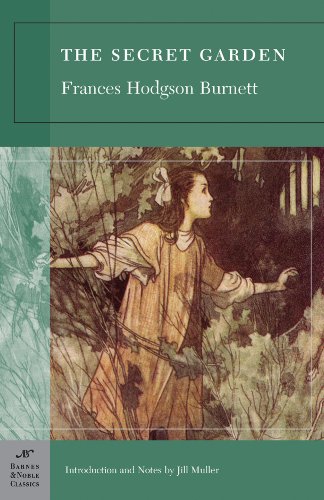
Children's/YA: The Secret Garden

Burnett, Frances Hodgson. The Secret Garden. New York: Barnes and Noble, 2005. 272 pages.

"When Mary Lennox is sent home an orphan from India to live with her hunchbacked uncle at Mistlethwait Manor, she can have little idea of the new life that awaits her there. She arrives a sour-faced, sickly little madam with a furious temper, but through her friendship with local Yorkshire lad, Dickon, and their discovery of a secret garden, soon becomes a happy and healthy girl. She shares her new-found love of life with her sickly cousin, Colin, and together the three children restore the garden to its former glory. Between them they work their magic on the garden, and in turn the garden works its magic on the children and everyone around them. Enchanting and illuminating, The Secret Garden is a richly imaginative story about the potential for transformation." (description from book jacket)

Overall Review: **** (out of five)

Strengths:
  • Description. Burnett's descriptions, whether of Mary in India, or the moor and the people on it, are rich and evocative.  I think that this especially important for young readers, as they get used to reading books without pictures, providing an excellent springboard for their imaginations.
  • Symbolism. The characters and landscapes in this book are highly symbolic, reflecting various changes in the characters and their relationships. This adds an added layer of meaning that children can appreciate as they get older.
 Weaknesses:
  • Time and Setting. A book set in Victorian England might seem odd and difficult to relate to for children, with them wondering about all sorts of things that are different now.  But the characters are so engaging that I hardly think it matters. Also, it could give children an opportunity to ask questions and learn some new things.

Friday, June 24, 2011

Film Friday: Jurassic Park

Crichton, Michael. Jurassic Park. New York: Ballantine Books, 1990. 399 pages.

"An astonishing technique for recovering and cloning dinosaur DNA has been discovered. Now mankind's most thrilling fantasies have come true. Creatures extinct for eons roam Jurassic Park with their awesome presence and profound mystery, and all the world can visit them--for a price. Until something goes wrong...." (description from book cover)

Book Rating: **** (out of five)
Film Rating: *** (out of five)

Strengths:
  • Premise. As a cautionary tale of the dangers of unbridled scientific power has the potential to be dry and didactic, but when the story is that we've used our power to create dinosaurs that are in turn destroying us is highly entertaining.  It is also absolutely terrifying at times.
  • Writing Style. Crichton's writing is engaging and when characters such as Ian Malcolm are explaining technical concepts, they are are clearly, while still being relevant to the plot.
Weaknesses:
  • Characterization. Some of the characters, such as Hammond, are rather one dimensional (though Crichton makes his narrow-minded focus disturbingly plausible).

Wednesday, June 22, 2011

Children/YA--The Girl Who Owned a City

Nelson, O.T. The Girl Who Owned a City. New York: Laurel Leaf, 1977.

"A killing virus has swept the earth, sparing only children through the age of twelve. There is chaos everywhere, even in formerly prosperous mid-America. Gangs and fierce armies of children begin to form almost immediately. It would be the same for children on Grand Avenue but for Lisa, a ten-year-old girl who becomes their leader. Because of Lisa, they have food, even toys, in abundance. And now they can protect themselves from the fierce gangs that roam the neighborhoods. But for how long? Then Lisa conceives the idea of a fortress, a city in which the children could live safely and happily always, and she intends to lead them there." (description from book cover)

Overall Rating: **** (out of five)

Strengths:
  • Strong Female Character.  As an antidote to some young adult fiction that girls read these days, it is nice to have a book where the main character is not worried about boys.  Rather, Lisa is worried about surviving by some method other than violence.
  • Premise.  The appeal of post-apocalyptic fiction is seeing ordinary people survive and even thrive.  What is more interesting than seeing the weakest and most unprepared members of society, children, attempting to face what we might consider grown-up challenges.
Weaknesses:
  • Violence. There is fighting, children with guns, and other potentially problematic behaviors in this book.  Usually, this is limited to the "bad guys" of the story, but in some cases the good guys, too.  It's not on the scale of The Hunger Games.


Monday, June 20, 2011

American Gods

Gaiman, Neil. American Gods. New York: Harper Torch, 2001. 588 pages.

"Shadow is a man with a past. But now he wants nothing more than to live a quiet life with his wife and stay out of trouble. Until he learns that she's been killed in a terrible accident. Flying home for the funeral, as a violent storm rocks the plane, a strange man in the seat next to him introduces himself. The man calls himself Mr. Wednesday, and he knows more about Shadow than is possible. He warns Shadow that a far bigger storm is coming. And from that moment on, nothing will ever be the same." (description from book cover)

Overall Rating: **** (out of five)

Strengths:
  • Premise. As he admits in the acknowledgements at the end of the book, Neil Gaiman is not the first author to discuss what gods, both modern and the modern fates of the increasingly archaic.  Yet Gaiman's sweeping narrative says so much about modern faith, but also how gods feel about being left behind. But more than that, as a non-native of the U.S., Gaiman is able to present an unflinching view about how this country treats gods, and it is fascinating.
  • Narrative Style.  In order to add substance to the feelings of the gods in America, the narrative jumps back in time to present stories of how different gods were brought to America by the beliefs of immigrants.  This not only highlights the breadth of the gods that came here, but how the difference in life here made it hard for them to survive.
Weaknesses:
  • Narrative Style.  While the stories presented in the flashbacks enhances the overall message of the novel, there are times when the main story line is so engrossing that the sudden shift in story feels jarring.
  • Language, Sex, Violence.  This is always a personal choice moment, but there is plenty of profanity, explicit sex (see "Somewhere in America" at the end of chapter 1), and quite a bit of violence.  If none of those are your cup of tea, then be forewarned.

Friday, June 17, 2011

Film Friday: Gone with the Wind

Mitchell, Margaret. Gone with the Wind. New York: Pocket Books, 1964. 1448 pages.

"Many novels have been written about the Civil War and its aftermath. None take us into the burning fields and cities of the American South as Gone with the Wind does, creating haunting scenes and thrilling portraits of characters so vivid that we remember their words and feel their fear and hunger for the rest of our lives. In the inimitable Scarlett O'Hara and Rhett Butler, Margaret Mitchell not only conveyed a timeless story of survival under the harshest of circumstances, she also created the two most famous lovers in the English-speaking world since Romeo and Juliet" (description from book cover)

Overall Review: **** (our of five)

Strengths:
  • Writing.  Everything else aside, Margaret Mitchell is a damn fine writer.  She's not afraid of using complicated words and language (unlike some modern authors I could mention) and her descriptions are vivid and lasting.
  • History. While her view is undoubtedly biased, Mitchell's descriptions of life during the Civil War and Reconstruction are painful and haunting, and (from my limited knowledge) fairly accurate.
Weaknesses:
  • Racism. The attitude of white Southerns towards blacks is patronizing and paternalistic, the Klu Klux Klan is a fine upstanding organization, and Northerners are crazy for thinking the Southerners mistreat their slaves.  But these sorts of items are few and far between, and are indicative of both the setting of the book and the time when Mitchell was writing.

Friday, June 10, 2011

Girl with a Pearl Earring

Chevalier, Tracy. Girl with a Pearl Earring. New York: Plume, 1999. 233 pages.

 "History and fiction merge seamlessly in Tracy Chevalier's luminous novel about artistic vision and sensual awakening. Through the eyes of sixteen-year-old Griet, the world of 1660s Holland comes dazzlingly alive in this richly imaginative portrait of the young woman who inspired one of Vermeer's most celebrated paintings." (description from the book cover)

Overall rating: **** (four stars)

Strengths:
  • Historical Setting. Chevalier paints a fascinating picture of life in Holland in the 1660s.  Not only does the novel explore the class differences in Delft, but also the religious differences. We also get to learn about the camera obscura and its role in Vermeer's painting.
  • Characterization of Vermeer. Though the novel is about one of his paintings, we do not see Vermeer as often as we might.  He says little, but Griet observes him carefully. The other characters, however, discuss him constantly.  This character creation not only serves to keep Vermeer elusive, it also imbues his moments of presence in the story with that much more meaning.
  • Description of Painting.  One of the most beautiful aspects of this novel is the exploration of Vermeer's way of seeing the world and his method of paining.  Chevalier also provides wonderful details of some of the technical aspects of painting, such as preparing the paint itself.
Weaknesses:
  •  Motivation.  Some of the ancillary characters are more two-dimensional than they might need to be. Van Ruijven is a fairly stereotypical lecherous rich man, and Vermeer's daughter Cornelia is spite personified. While they elegantly serve their purpose, they could be more fleshed out.
  • Dialogue.  For a first person narrator, Griet is fairly silent. She thinks a great deal and listens to other characters, but she says little herself. For people who need dialogue to understand a character, this may be a problem.  The novel is highly internal, rather than based on action, and this could be a problem for some people.

Monday, June 6, 2011

Madame Tussaud

Moran, Michelle. Madame Tussaud. New York: Crown Publishers, 2011. 448 pages.

"Smart and ambitious, Marie Tussaud has learned the secrets of wax sculpting by working alongside her uncle in their celebrated wax museum, the Salon de Cire.  From her popular model  of the American ambassador, Thomas Jefferson, to her tableau of the royal family at dinner, Marie's museum provides Parisians with the very latest news on fashion, gossip, and even politics....Will Marie be able to hold on to both the love of her life and her friendship with the royal family as France approaches civil war?  And more important, will she be able to fulfill the demands of powerful revolutionaries who ask that she make the death masks of beheaded aristocrats, some of whom she knows?  Spanning five years, from the budding revolution to the Reign of Terror, Madame Tussaud brings us into the world of an incredible heroine whose talent for wax modeling saved her life and preserved the faces of a vanquished kingdom." (description from the book dust jacket)

Overall rating: **** (four stars)

Strengths:
  • Main Character. Marie Grosholtz (later Tussaud) was a strong, single career woman back before such a thing really existed. Her story is compelling and provides and excellent platform for a book about the horrible tragedy that was the French Revolution.
  • Other Historical Figures. Some of the most fascinating historical developments in the book relate to the more ancillary characters, such as Robespierre or Marat.  We see the change in Robespierre from talkative commoner at a political salon to the architect of the Reign of Terror.  And seeing Marat through Marie's eyes, it is less than sad when he is stabbed in his bath.  
  • French Culture. The presentation of the importance of the newspapers and Marie's Salon as venues for new is a fascinating insight into life very much before the information age.
Weaknesses:
  • Historical Liberties. It is a historical novel and, as such, the writer has altered some bits of history in the narrative to make for a better story (which she addresses very well in her historical note at the end).
  • Character Development. There are a few times near the beginning of the book when a character has a change of heart or does something without what seems like adequate motivation.  These moments are rare and fade out, so they do not detract too much.

Friday, June 3, 2011

The Da Vinci Code

Brown, Dan. The Da Vinci Code. Doubleday: New York, 2003. 452 pages.

"While in Paris on business, Harvard symbologist Robert Langdon receives an urgent late-night phone call. The elderly curator of the Louvre has been murdered inside the museum, a baffling cypher found near the body. As Langdon and a gifted French cryptologist, Sophie Neveu, sort through the bizarre riddles, they are stunned to discover a trail of clues hidden in the works of Da Vinci....Langdon and Neveu find themselves matching wits with a faceless powerbroker who appears to anticipate their every move. Unless they can decipher the labrynthine puzzle, the Priory's secret--and an explosive ancient truth--will be lost forever." (description from the book dust jacket)

Overall review: *** (three stars)

Strengths:
  • Pacing.  The book keeps a fairly constant fast pace which draws the reader quickly through the book without making it feel like the mysteries and riddles are being solved too quickly.
  • Riddles.  Sometimes "obvious" sounding riddles or prophecies in stories can end up having solutions that seem to be stretching credulity a bit (see "no man of woman born" in Macbeth).  Brown's linguistic puzzles, however, are well-constructed with reasonable and fitting solutions.
  • General Plot.  Despite some weaknesses (see below), the plot is engaging and hooks the reader fairly early, even if you disagree with some of the interpretations presented by the characters.
Weaknesses:
  • Character Motivation.  At times the motivation of the characters feels contrived or convenient rather than realistic. Characters should never feel as though they are simply serving the plot at the convenience of the author.
  • Conspiracy Theories.  Yes, the theories presented in this book are compelling.  However, there are times when characters seem to be making interpretations that seem a bit far-fetched. (Let's face it: sometimes men in Renaissance art look like our idea of women.  That's just the way it is.  See the angel in the Virgin of the Rocks, about which Dan Brown makes other comments.  Totally looks like a chick.)
  • Portrayal of Religion.  Despite some comments obviously tossed in to show that the book is not anti-religion, the Catholic Church is not portrayed in a particularly flattering light.  This may or may not bother readers, depending on their religious inclinations and feelings about Catholicism.

Monday, May 30, 2011

The Beekeeper's Apprentice: Or On the Segregation of the Queen

King, Laurie R. The Beekeeper's Apprentice: Or On the Segregation of the Queen. New York: Picador, 1994. 346 pages.

"In 1915, Sherlock Holmes is retired and quietly engaged in the study of honeybees when a young woman literally stumbles into him on the Sussex Downs.  Fifteen years old, gawky, egotistical, and recently orphaned, the young Mary Russell displays intellect to impress even Sherlock Holmes--and match him wit for wit. Under his reluctant tutelage, this very modern twentieth-century woman proves a deft protegee and a fitting partner for the Victorian detective." (description from the book cover)

Overall rating: ***** (five stars)

Strengths:
  • Subtle social commentary.  Though this book is not about WWI, many interesting observations are made of the effect of the war on British society.  This is a theme which becomes more important in later books.
  • Narrative style.  The book is told in first person narration by someone who is looking back over past experiences.  This often leads to amusing side notes by the narrator. ("Looking back I am deeply embarrassed at the effrontery of a girl not yet nineteen pointing her finger at a man nearly three times her age, and her teacher to boot, but at the time it seemed appropriate.")
  • The mysteries.  In many mystery books, such as Agatha Christie's Hercule Poirot stories and the original Holmes stories by Doyle, the detective is entirely outside the case, with the only personal thing at stake being the detective's reputation. King is not afraid to bring the mysteries home to her protagonists, giving us more emotional insight in the psychological tolls of such work.
  • Characterization. Not only are the two main characters both fully-fleshed, real people with plenty of strengths and flaws, the minor characters are never treated just as handy tools to move along the plot.
Weaknesses:
  • Chronology.  Early in the book, the narration skips about in time a bit, making it a wee bit difficult to keep the chronology straight until the book has settled back down into a more linear structure.
  • Appropriation of an already existing character.  This is not a problem for me, but for anyone who is a Sherlock Holmes purist and who strongly disapproves of anyone trying to write stories about someone else's characters, I would not recommend reading this.