"All books are either dreams or swords,/You can cut, or you can drug, with words." - Amy Lowell, 'Sword Blades and Poppy Seed'

Wednesday, September 5, 2012

Children's/YA: Pathfinder

Card, Orson Scott. Pathfinder. New York: Simon Pulse, 2010. 657 pages.

"Rigg is well trained at keeping secrets. Only his father knows the truth about Rigg's strange talent for seeing the paths of people's pasts. But when his father dies, Rigg is stunned to learn just how many secrets Father had kept from him -- secrets about Rigg's own past, his identity, his destiny. And when Rigg discovers that he has the power not only to see the past, but also to change it, his future suddenly becomes anything but certain.
Rigg's birthright set him on a path that leaves him caught between two factions, one that wants him crowned, and one that wants him dead. He will be forced to question everything he thinks he knows, choose who to trust, and push the limits of his talent...or forfeit control of his destiny." (description from back cover of book)

Overall Rating: **** (out of five)

Strengths:
  • Richness of Plot. It takes a great deal of talent to successfully combine to seemingly disparate stories in one novel, and reveal just enough about each that by the end of the book, the reader can see clearly how they are connected.  Not only that, but each plot is fully essential to the understanding of the other.
  • Writing. It can be difficult to find novels that combine excellent writing that can appeal to, or even challenge, advanced readers with a plot that will still appeal to a young adult audience.  Think of it as the general theme of the first Harry Potter book, a young person learning about an unknown heritage and exploring a new, but with the complexity of storytelling and general writing style present in the later Harry Potter books.

Weaknesses:
  • Characters.  While the characters are fascinating and fun to read about, readers might find Rigg, the main character, difficult to relate to.  Though his father has died and sent him off into an increasingly hostile world, he is something of a know-it-all who is in control of almost every situation.  Given the way the book ends, I can only assume that will change in the next book. It is a minor flaw, but one that might bother some readers.

Monday, September 3, 2012

Feed

Grant, Mira. Feed. New York: Orbit, 2010. 608 pages
(I read it as an e-book)

Set about 26 years after the Rising, the book takes place in a world where zombies are certainly still dangerous, but they are also a fact of life.  Bloggers, such as Georgia and Shaun Mason, are serious journalists, and journalism requires weapons testing and licensing.  It's a recognizable yet irretrievably different world.  Blood test are as common as washing your hands, and Alaska has been lost to the undead. The entire world population is infected with Kellis-Amberlee, the unintentional hybrid of the cure for cancer and the cure for the common cold that raises the dead.  While covering presidential candidate Peter Ryman, Georgia, Shaun and their blogging team discover a political conspiracy involving people who are not afraid to use Kellis-Amberlee as a weapon.

Overall Rating: **** (out of five)

Strengths:
  • Rich Woldbuilding.  The world of the U.S. in 2040 is not only a believable projection of what our world would be like if we combined modern technology and society with a world where zombies are the norm, but it is described with a richness that makes it real.  Comments from the characters about life "pre-Rising" helps the reader understand just how drastically the zombies have changed many aspects of life that we would take for granted.
  • Plot.  In exploring a world that has reached a sense of equilibrium with zombies, rather than one suddenly hit by a zombie apocalypse, Grant has the freedom to write a book where zombies are integral to the plot without actually being the plot. For anyone who likes meaty political conspiracy thrillers, this is definitely a book for you.
  • Scientific Grounding.  Kellis-Amberlee, the hybrid virus that causes zombies, is extremely well created.  The basis of this book in virology, how viruses behave and spread, and how society might deal with worldwide epidemic, are excellently portrayed.
Weaknesses:
  • Characterizations.  At points during the book, some of the characters are just a bit flat and static.  This is not frequent, and is usually compensated for by the quality of the plot and the other characters.  This is mostly related to Senator Ryman, as he frankly seems too good to be true at times.  As this is a fact recognized by the other characters as well, it is clearly an intentional choice, and is easy enough to overlook.
Warnings: Extreme violence and profanity, both of which are understandable when confronting zombies, but an FYI that there's a lot of both.

Friday, August 26, 2011

Film Friday pt. 2: 10 Things I Hate About You

Okay, so, we've talked about reading it and seeing the play.  But there have been plenty of movies based on The Taming of the Shrew, and the one I've chosen to talk about is 10 Things I Hate About You.  Obviously, the most important thing about the movie is that Heath Ledger wonderfully serenades Julia Styles with "Can't Take My Eyes Off You."  Well, to some of us anyway.  The movie deals with the complication of the play by eliminating it.  Patrick Verona (Petruchio) does not starve or sleep deprive Kat (Kate).  He is just very nice to her.  Though, when Petruchio first meets Kate, he does the same thing.  He spend the entire time complementing her, no matter how "shrewish" she is.  The Bianca (aptly named Bianca) is much more likable in the movie, and since we actually see her relationship develop with Cameron (Lucentio), it is more believable that they will actually be happy together.

It may seem unlikely that a Shakespeare play set in a contemporary high school in California would be successful, but the general plot suits teenagers well.  It works well as an adaptation of a classic work for a modern audience.  Kat's father actually likes her, he's simply paranoid about teenage pregnancy, so he uses Kat's disinclination to date to keep Bianca at home.  And this is something I particularly like about the movie: it focuses much more on the family relationship.  We see both daughters interacting with their father, and we actually see more interaction between Kat and Bianca.  Because they actually care about each other, when they admit difficult things to each other, it makes it all more meaningful. 

Naturally, in simplifying the play and smoothing off the rough edges, the movie loses some of the richness of the play.  But it maintains much of the essence, acting as an excellent interpretation of the play.  And, of course, if it inspires more people to explore Shakespeare, then it has done an excellent job.

Theater Week/Film Friday: The Taming of the Shrew

Shakespeare, William. The Taming of the Shrew. New York: Barnes and Noble Shakespeare. 291 pages.

The Taming of the Shrew is a problematic and complex play, and is all the more enjoyable for both of these qualities. Before this summer, I'd seen it twice, but I'd never read it.  Reading it not only reminded me how much I enjoy reading Shakespeare, but it also reminded me just how rich and rewarding this play is, as long as you are willing to think about it.  To begin with, Bianca has much more of a role in the play than I remembered.  It is easy to think of the play as the Kate and Petruchio show, but it is equally about Bianca and her suitors. I also noticed how Kate's father seems to prefer Bianca to her, and one has to wonder if Kate is a shrew because her father prefers Bianca, or if her father prefers Bianca because because Kate is a shrew.  Either way, Kate does not seem to have the happiest home life, and it seems to have embittered her (just a bit).  Kate's speech at the end is certainly infamous, but it is important to notice that Kate and Petruchio seem to have formed a working partnership, whereas Bianca and her husband have not.

I'm used to reading Folger Shakespeare editions of the plays, but for this one I had to get the Barnes and Noble Shakespeare, and I found it to be both informative and user friendly, not just a Folger Shakespeare knock-off.  The notes not only explained words and phraseology that have become anachronistic, but it also placed certain comments in the context of the play itself, such as what Shakespeare might have meant by giving Lucentio such flowery lines ("I burn, I pine, I perish") when he first sees Bianca.  For anyone looking to delve into Shakespeare for the first time, I highly recommend these editions.

As for the play, the director obviously had a clear interpretation of the play.  For him, the "taming" of Kate was less an act of domination and more an act of compassion. Petruchio wanted to mold Kate into, not a more traditional woman, but one who could function in society without being a mean person.  Shakespeare does not take away Kate's snarky tongue, since at the end Petruchio encourages Kate to bring the widow down a peg.  Rather, Petruchio wants Kate to trust him, and he wants to prove to her that he will be there for her. I confess, I care less about whether I agree with a director's interpretation of Shakespeare than whether the vision is strong enough to carry the play (because I have seen instances where it wasn't).  But the director didn't just focus on Kate and Petruchio.  He also had ideas about Bianca and her suitors, and about Lucentio and Tranio. The whole play had a cohesive feel, and every character was important.  When Kate made her speech at the end, with utmost sincerity, it may have begun as a lecture to Bianca and the widow, but it turned into a demonstration to Petruchio of how much she loved and trusted him.

What helped illuminate the production and open new insights onto the director's view of the play was one of a series of podcasts produced by APT this season, called Behind the Curtain.  If for no other reason than it presents interesting views of the play, I'd highly recommend listening to it.  You can listen to the podcasts online here, or you can download them from iTunes.

Thursday, August 25, 2011

Theater Week: Crime and Punishment

Crime and Punishment was the only play I hadn't read before seeing it this past weekend, and I think it may have worked best that way.  The program labeled the setting of the play as "the Mind of Raskolnikov," which gave the play a more stream of consciousness feel than could come from a traditional linear plot.  It had three actors: one for Raskolnikov, a second as Sonia and all the other women, and a third as Porfiry and Sonia's father.  The play flowed the way life usually does, with something Porfiry says triggering Raskolnikov's memories, which he steps back into, before coming back to the present.  For those who don't know, I'm not spoiling anything by saying that  Raskonikov commits two murders. I assume they happen near the beginning of the novel, but we don't see them in the play until half or two-thirds of the way through.

The structure of the play, combined with all of the supporting characters being played by two actors serves to focus on Raskolnikov's mental state, and its decline from guilt. The acting required to carry all of this off was absolutely superb.  While playing multiple characters successfully is certainly impressive, it was the changes in individual characters (specifically Raskolnikov and Porfiry) that were the most impressive. When Porfiry came clean to Raskolnikov about what he knew, at was as if a switch had been flipped. He was a different person, though he maintained the same core of compassion throughout. Raskolnikov's decline was raw and absolutely excruciating.

The play took place in APTs indoor theater, a small, extremely intimate space that served to concentrate all of the emotions from the play, making them stronger and more intense. It also created a deeper relationship between the audience and what was taking place on stage.  That made it extremely powerful when Raskolnikov broke the fourth wall and tried to justify his actions to the audience and himself. When the lights went out at the end, I am sure I'm not the only person in the theater crying (including the actors).  It was an experience that will stay withe me for a long time. I definitely want to read the book now, but I find it hard to imagine that it can be any more powerful than the show.  When I read it, I'll be sure to let you know :)

Tuesday, August 23, 2011

Theater Week: Of Mice and Men

Steinbeck, John. Of Mice and Men. New York: Dramatists Play Services, 1964. 71 pages.

I know I said in my post last week that I hadn't read Of Mice and Men. Well, I picked up a copy of the script on the trip and read it before seeing it.

Now, before I begin, I ought to confess that I have never liked John Steinbeck. I read The Pearl in seventh grade and  The Grapes of Wrath in my junior year of high school, and I did not like either of them. In fact, I strongly disliked both of them. So I wasn't hugely enthusiastic about seeing a Steinbeck play. After I read the script, however, things began to look up. I found the plot and characters to be more engaging and sympathetic than in my previous experiences with his writing. And the ending was heartbreaking. I found it interesting that the stage directions explicitly say that there's no need to be realistic with the set and some of the props (such as Candy's dog and Lennie's puppy). Nothing in the play, no bit of action or line of dialogue was unnecessary. Everything moved toward the final tragedy.

So, I was finally looking forward to seeing the play by the time we sat down. For the second evening in a row, I found myself crying at the curtain call. The play was extraordinarily moving, with absolutely fabulous acting from the entire cast. George was less angry and antagonistic toward Lennie than suggested  by the notes in the play, which made the ending even more poignant. I also appreciated the portrayal of Lennie. It would be easy to make Lennie a caricature of stupidity, but instead he was just simple and sweet-natured, with an absolute devotion to George. George and Lennie's effect on the ranch is profound, and they spread hope and make some friends, and a few enemies.  When the dangerous naivety of Curly's wife brings everything down, the tragedy seems inevitable.

The set design was fairly realistic, with a small rive cut into the stage for the opening scenes. Curly's dog never appeared on stage, which worked just fine. Not surprisingly, the stage being outdoors was absolutely perfect for the play, adding the right touch of verisimilitude. It was a beautiful ensemble cast with absolutely wonderful chemistry. I think it has even started changing mind toward Steinbeck...

Monday, August 22, 2011

Theater Week: Blithe Spirit

Coward, Noel. Blithe Spirit in Three Plays. New York: Vintage International. 102 pages (for just Blithe Spirit).

Let's start off the week with one of the comedies, though it was the third play I saw this weekend: Blithe Spirit by Noel Coward.  Since I will be focusing on comparisons between reading the plays and seeing them, my posts this week won't follow the normal structure of my book reviews.

In my copy of Blithe Spirit, the play is referred to as an "improbable farce," which is a fairly apt description. A novelist (Charles) and his wife (Ruth) invite a medium to preform a seance for themselves and some guests, as research for Charles's new book. The medium ends up summoning the ghost of Charles's first wife (Elvira). As Charles is the only one who can see her, hijinks not surprisingly ensue. Noel Coward's strength is certainly his dialogue ("Surely even a protoplasmic manifestation has the right to expect a little of the milk of human kindness."), which certainly comes across in reading the play, as of course does the general ridiculousness of the plot. None of the three main characters is close to perfect, but each of them thinks they are perfectly in the right.

When reading the play, I assumed that the humor would come almost entirely from the dialogue. What I discovered from actually seeing the play were all of the possibilities for physical humor. The majority of it comes from Madame Arcati (the medium) and Elvira.  The production at APT took full advantage of these possibilities, with Madame Arcati's seances played to their fullest possible extents. And Elvira took full advantage of being unseen to flop all over the furniture and play tricks on people, such as watching people talk to thin air where they think she's standing. And that was one of the most impressive things of the whole show: the other characters' ability to not see her. They weren't ignoring her, that would have been obvious. They simply weren't seeing her.

The show also had one of those joys of live theater: ad-libbing. The main stage (Up-the-Hill) theater at APT is outdoors in a beautiful natural amphitheater. This means that the outside world can intrude on the play. During this performance, there was a particularly loud and annoying plane that seemed to be circling overhead. Charles told his doctor that he was planning on going into town, to which the doctor replied "I hope not by plane." It got one of the biggest laughs of the afternoon.  It's moments like that, creating that connection between the audience and the actors, that is truly the biggest difference between reading a play and seeing it live.

If you are interested in learning more about APT, check out their website: http://americanplayers.org/

Monday, August 15, 2011

Brief Break for Vacation and the Inaugural Theater Week

First of all, I apologize for the lack of posts last week.  One of my close friends moved to New Jersey last week, and I helped her pack and hosted her for a few nights before she left. 

I am also leaving for vacation this week (which means that evenings are taken up with packing and laundry).  Every year, my family goes to see plays at American Players Theatre in Spring Green Wisconsin. I have read three of the plays we're seeing: The Taming of the Shrew by William Shakespeare, Blithe Spirit by Noel Coward, and The Glass Menagerie by Tennessee Williams.  Ironically for the purposes of this blog, the two I have not seen (Crime and Punishment and Of Mice and Men) are both based on books.  Next week, my reviews will be of the three plays I've read, and will combine impressions of the plays as both books and performances.  This will be my inaugural Theater Week. If it goes well, then I will do it again next year (assuming whatever job I get post graduation permits seeing plays). So, next week, look forward to what promise to be some entertaining plays :)

Monday, August 8, 2011

Clapton: The Autobiography

Clapton, Eric. Clapton: The Autobiography. New York: Broadway Books, 2007. 328 pages.

"More than a rock star, Eric Clapton is an icon, a living embodiment of the history of rock music.  Well known for his reserve in a profession marked by self-promotion, flamboyance, and spin, he now chronicles, for the first time, his remarkable personal and professional journeys....Clapton is the powerfully written story of a survivor, a man who has achieved the pinnacle of success despite extraordinary demons. It is one of the most compelling memoirs of our time." (description from book jacket)

Overall Rating: *** (out of five)

Strengths:
  • Tone. The general narrative style is casual and personal, like having a friend sitting and telling you a story. This helps draw the reader into the narrative.
Weaknesses:
  • Writing. In spite of the author's enthusiasm, the quality of the writing, though not horrible, is by no means memorable or outstanding in any way, which makes it a bit difficult to get into the story.
  • Plotting. Both the beginning and end of the story feel less like a cohesive narrative with a point and more like a repetition of events that have been put their for the sake of completeness rather than because they truly serve the story.

Friday, August 5, 2011

Film Friday: Casino Royale

Fleming, Ian. Casino Royale. New York: Penguin, 1953.

"Introducing James Bond: charming, sophisticated, handsome; chillingly ruthless and licensed to kill. This, the first of Ian Fleming's tales of secret agent 007, finds Bond on a mission to neutralize a lethal, high-rolling Russian operative called simply "Le Chiffre"--by ruining him at the Baccarat table and forcing his Soviet spymasters to 'retire' him. It seems that lady luck is taken with 007--Le Chiffre has hit a losing streak. But some people just refuse to play by the rules, and Bond's attraction to a beautiful female agent leads him to disaster and an unexpected savior." (description from book cover)

Book Rating: *** (out of five)
Movie Rating: **** (out of five)

Strengths:
  • Plot. Fleming's inaugural James bond novel is certainly gripping.  Bombs, hit men, torture, gambling, sex. This book has it all, and the mixture is entertaining. Fleming's world of espionage is based backstabbing and double agents, and he knows just how far to go before it gets ridiculous.
  • Lack of Judgement. I like authors who present their characters on their own merits,without trying to force a ready-made definition of good or evil down the audiences' throats, and Fleming often succeeds at doing just that.
Weaknesses:
  • Dialogue. Fleming may be able to spin a yarn, but his characters could use some better self-expression.  It's not that it is overtly cliched, it simply seems stilted at times.
  • Sex and Violence. As I think most people know to expect, the book has plenty of, well, sex and violence. There are also less than flattering observations made of the women in the book, though the sexism is more tempered than I anticipated.

Wednesday, August 3, 2011

Children's/YA: April's Kittens

Newberry, Clare Turlay. April's Kittens. Troll Associates, 1969.

A book about April, a girl who lives with her parents and cat, Sheba, in a one-cat apartment. However, what happens when Sheba has three kittens?  April's father insists that three cats must go. What will April do when she falls in love with one of the kittens? Does she keep Sheba or the kitten? (original description).

Overall Rating: ****(out of five)

Strengths:
  • Story. This story emphasizes one of the most important aspects of family life: compromise.  The best part, however, is that we see compromise from both the child and the parents, which teaches the importance and equality of every member of the family.
  • Illustrations. The illustrations of the book are absolutely beautiful.  They are simply black, white, and pink, and their softness is nearly tactile.  You just want to pick up the kittens and cuddle with them.
Weaknesses:
  • Story to Illustration Ratio. For small children who cannot yet read, the story is what they hear their parents saying and the pictures they see on the page. I feel as though the book might be more effective for kids who can't read if it had more illustrations.

Monday, August 1, 2011

Bored of the Rings

Beard, Henry N. and Douglas C. Kenney. Bored of the Rings. New York: Signet, 1969.

"'Never have I laughed so hard at any other book. The Harvard Lampoon's BORED OF THE RINGS is unquestionably a comic masterpiece as well as a brilliant parody of J.R.R. Tolkien's famous THE LORD OF THE RINGS trilogy. A gem of irreverence...filled with an incredible menagerie of mad characters including lustful Elf-maidens and a roller-skating dragon. A side-splitting swipe at the Eternal Quest and the castles, wizards and other folderol of 'ancient' lore...a CATCH-22 for lovers of the days of yore.'" (Harvard Daily News description from book jacket)

Overall Review: *** (out of five)

Strengths:
  • Intelligent Humor. It is obvious that the writers of this book both know the material they are mocking and a great deal about intellectual history and the pop culture of their time. Most of the jokes in the book are spot on, including the meta-humor.
Weaknesses:
  • Dated Humor. Many of the jokes are very specific to the culture of the '60s.  This means that some of these jokes would go over the head of younger audiences, unless they happen to be up on their 1960s history.
  • General Drug Use and Amorality. It is difficult to mock the '60s without their being references to drugs and sex. So, while there is pervasive bad behavior, it is important to remember that it is mocking these practices, not condoning them.

Friday, July 29, 2011

Film Friday: Sin City

Miller, Frank. Sin City. Vol. 1: The Hard Goodbye. Milwauke, OR: Dark Horse, 2005.

A Woman named Goldie takes pity on an unattractive and unstable man named Marv, and when she's murdered in bed with him, he sets out to not only discover who framed him, but to get revenge for one of the few women to ever show him kindness.  His quest for answers leads him to a tangle of political deceit centered around a man with somewhat...unusual appetites. But all of this is just business as usual in the crime-riddled Basin City.

Book Rating: **** (out of five)
Movie Rating: **** (out of five)

Strengths:
  • Drawings. Frank Miller's drawing style is dark and evocative.  In this particular story, there's no color, just pure black and white.  Miller switches between detailed images and outlines and shadows, which creates a feeling very much like film noir.
  • Plot. The story is dark and disturbing (not kidding, corruption and cannibalism, for beginners) but it sucks you in.  Marv exemplifies the "anti" in anti-hero, and in spite of his issues,  he is a sympathetic character.
Weakneses:
  • Sex and Violence. This book is a graphic novel, in more ways than one.  Murder, hookers, and did I mention cannibalism earlier? Yeah...  Razor wire, and sawing off limbs, and, oh yeah, corrupt clergy who are covering up the murder of prostitutes.  Stay away if such things offend you.

Wednesday, July 27, 2011

Children's/YA: The Witches

Dahl, Roald. The Witches. New York: Puffin, 1983. 208 pages.

"'A REAL WITCH is easily the most terrifying thing on earth.' That's a pretty thought. More horrifying still is that real witches don't even look like witches. They don't ride around on broomsticks. They don't even wear black cloaks and hats. They are vile, despicable, scheming harridans who disguise themselves as nice, ordinary ladies. So how can you tell when you're face to face with one? Read this story and you'll find out all you need to know. You'll meet a real hero, a wise old grandmother and the most gruesome, grotesque gang of witches imaginable!"

Overall Rating: **** (out of five)

Strengths:
  • Trustworthy Adult. The grandmother in this story is every child's dream authority figure.  She tells you all those deliciously scary stories that parents don't want children to hear.  She takes you on fun vacations.  And when your confrontations with witches go sour, she loves you anyway.  Who wouldn't want that?
  • Exciting Story. Let's face it, this book is a wonderful adventure story for children. It has a wonderful everyman hero and a whole cast of dastardly villains. If the boy was Harrison Ford and the witches were secretly Nazis, it could be an Indiana Jones movie. Well, almost. But it's that kind of black and white, unapologetic adventure tale, but for kids.
Weaknesses:
  • The Witches. The witches as described in the book, are fairly terrifying. Any child taking it seriously would be looking sideways at all women forever, looking for enlarged nostrils or toeless feet, or signs of a wig, or blue spit. While this doesn't seem to be a problem with most children, it is worth keeping in mind.

Monday, July 25, 2011

The Murder of Roger Ackroyd

Christie, Agatha. The Murder of Roger Ackroyd. New York: HarperCollins, 2011. 304 pages.

"Roger Ackroyd knew too much. He knew that the women he loved had poisoned her brutal first husband. He suspected also that someone had been blackmailing her. Then, tragically, came the news that she had taken her own life with a drug overdose. But the evening post brought Roger one last fatal scrap of information. Unfortunately, before he could finish reading the letter, he was stabbed to death." (description from book cover)

Overall Rating: *** (out of five)

Strengths:
  • Mystery. Christie's classic locker room mystery is well-constructed, not surprisingly.  The story provides all the clues to solving it, but the conclusion can still come as a surprise.  While people familiar with Christie's writing might know enough to assume that the obvious suspect may not be the right one, there are loose threads galore that complicate the solving of the mystery.
Weaknesses:
  • Plot.  Though the mystery is good, the surrounding plot is less than stellar.  It seems as though all of the actual story happens in the brief period before the murder and Poirot's arrival.  This sort of mystery that is focused more on clues than characters works better as a short story than requiring the development of a novel.  The mystery is compelling enough to over come this, however.
  • Characterization. The sub-par plot is compounded by the one-dimensionality of the characters.  Their tendency toward being one-note stereotypes rather than fully realized people can make the reader wonder why they should care about them. The mystery is compelling enough to over come this, however.

Wednesday, July 20, 2011

Children's/YA: The Phantom Tollbooth

Juster, Norton. The Phantom Tollbooth. New York: Bullseye Books, 1989. 256 pages.

"For Milo, everything's a bore. When a tollbooth mysteriously appears in his room, he drives through only because he's got nothing better to do. But on the other side, things seem different. Milo visits the island of conclusions (you get there by jumping), learns about time from a ticking watchdog named Tock, and , even embarks on a quest to rescue Rhyme and Reason! Somewhere along the way, Milo realizes something astonishing. Life is far from dull. In fact, it's exciting beyond his wildest dreams!" (description from book cover)

Overall Rating: ***** (out of five)

Strengths:
  • Story. The idea of a mysterious package showing up in a boy's room to try and drag him into an appreciation for life is just fun.  I can think of times when life has gotten into a rut of repetition that a surprise trip to a magic land would have been in order.
  • Wordplay.  In terms of clever character names and witty references, Norton Juster is Jasper Fforde for kids (without all the literary allusions). With characters like Short Shrift, Faintly Macabre, and Kakofonous A. Dischord.
Weaknesses:
  • Heavyhandedness.  The allegorical nature of the story can some times lead to a lack of subtlety in the message of the story. After all, Milo is on a hunt for Rhyme and Reason.  I think it comes off as clever, but it might annoy some people.

Monday, July 18, 2011

Ubik

Dick, Philip K. Ubik. In Four Novels of the 1960s. New York: Library of America, 1997. 189 pages (for Ubik, which is pages 609-798)

Overall Rating: **** (out of five)

"Ubik (1969), with its future world of psychic espionage agents and cryonically frozen patients inhabiting an illusory 'half-life,' pursues Dick's theme of simulated realities and false perceptions to ever more disturbing conclusions, as time collapses on itself and characters stranded in past eras search desperately for the elusive, constantly shape-shifting panacea Ubik." (description from book jacket)

Strengths:
  • Premise. The idea of putting people who are dead, but not entirely dead (insert Princess Bride joke about being mostly dead here) being put in stasis where they live in an alternate world, but can be communicated with once and awhile is interesting. Particularly once the worlds start bleeding into each other.
  • Writing Style. Dick's style is descriptive and simple, which suits the complexity of the plot well.
Weaknesses:
  • Complexity of Plot.  Dick's plot can be convoluted, and the futuristic world of 1992 that he created can be a little hard to follow. At times it has a hallucinogenic quality that might not be to everybody's taste.

Friday, July 15, 2011

Film Friday: Harry Potter and the Sorcerer's Stone

Rowling, J.K. Harry Potter and the Sorcerer's Stone. New York: Arthur A. Levine, 1997. 309 pages.

"Harry Potter has never been the star of a Quidditch team, scoring points while riding a broom far above the ground. He knows no spells, has never helped to hatch a dragon and has never worn a cloak of invisibility. All he knows is a miserable life with the Dursleys, his horrible aunt and uncle, and their abominable son, Dudley--a great big swollen spoiled bully. Harry's room is a tiny closet at the foot of the stairs, and he hasn't had a birthday party in eleven years. But all that is about to change when mysterious letter arrives by owl messenger: a letter with an invitation to an incredible place that Harry--and anyone who reads about him--will find unforgettable. For it's there that he finds not only friends, aerial sports, and magic in everything from classes to meals, but a great discovery that's been waiting for him...if Harry can survive the encounter." (description from book jacket)

Book Review: **** (out of five)
Movie Review: ** (out of five)

Strengths:
  • Engaging Characters. The main characters in this book offer something for everybody.  None of them are even close to being perfect, but that makes them more relateable for children.  It is encouraging for children to see misfits making friends and succeeding, while struggling with all of the normal trials of adolescence, such as school work and teachers who play favorites.
  • Well-Realized World. One of the things that makes the book interesting is the idea of a world of magic hiding just around the corner of the world we know and sometimes love.
Weaknesses:
  • Minor Characters. Some of the ancillary characters are somewhat one-dimensional, which is not as much of a problem in children's books, since kids tend to see the world in black and white. I could envision this annoying some of the adults (but stick with the series. it gets better).

Wednesday, July 13, 2011

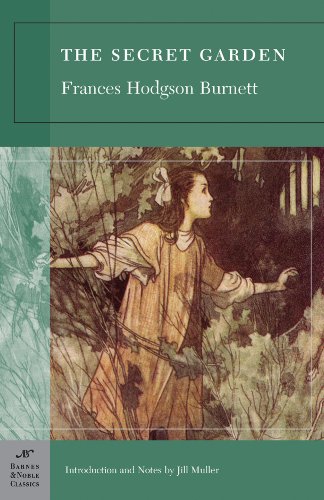
Children's/YA: The Secret Garden

Burnett, Frances Hodgson. The Secret Garden. New York: Barnes and Noble, 2005. 272 pages.

"When Mary Lennox is sent home an orphan from India to live with her hunchbacked uncle at Mistlethwait Manor, she can have little idea of the new life that awaits her there. She arrives a sour-faced, sickly little madam with a furious temper, but through her friendship with local Yorkshire lad, Dickon, and their discovery of a secret garden, soon becomes a happy and healthy girl. She shares her new-found love of life with her sickly cousin, Colin, and together the three children restore the garden to its former glory. Between them they work their magic on the garden, and in turn the garden works its magic on the children and everyone around them. Enchanting and illuminating, The Secret Garden is a richly imaginative story about the potential for transformation." (description from book jacket)

Overall Review: **** (out of five)

Strengths:
  • Description. Burnett's descriptions, whether of Mary in India, or the moor and the people on it, are rich and evocative.  I think that this especially important for young readers, as they get used to reading books without pictures, providing an excellent springboard for their imaginations.
  • Symbolism. The characters and landscapes in this book are highly symbolic, reflecting various changes in the characters and their relationships. This adds an added layer of meaning that children can appreciate as they get older.
 Weaknesses:
  • Time and Setting. A book set in Victorian England might seem odd and difficult to relate to for children, with them wondering about all sorts of things that are different now.  But the characters are so engaging that I hardly think it matters. Also, it could give children an opportunity to ask questions and learn some new things.

Monday, July 11, 2011

A Midwife's Tale

Ulrich, Laurel Thatcher. A Midwife's Tale: The Life of Martha Ballard, Based on Her Diary, 1785-1812. New York: Vintage, 1990. 444 pages.

"Between 1785 and 1812 a midwife and healer named Martha Ballard kept a diary that recorded her arduous work (in 27 years she attended 816 births) as well as her domestic life in Hallowell, Maine.  On the basis of that diary, Laural Thatcher Ulrich give us an intimate and densely imagined portrait, not only of the industrious and reticent Martha Ballard but of her society -- a portrait that sheds light on its medical practices, religious squabbles and sexual mores. At once lively and impeccably scholarly, A Midwife's Tale is a triumph of history on a human scale." (description from book cover)

 Overall Review: **** (out of five)

Strengths:
  • Fascinating Story. Few works about early America focus on women, particularly non-famous women.  Ulrich's work focuses on one woman, a midwife, and what her diary says not only about her daily life, but also about her family and the culture of her town.  And Martha Ballard's story is interesting, because it shows how wide the involvement of a woman could be in the community.
  • Narrative Style. Ulrich begins each chapter with the relevant entries from Ballard's diary, followed by Ulrich's interpretation and  analysis.  Not only does this introduce the reader to her most important primary source, but it also gives transparency to her discussions of her process of research.
Weaknesses:
  • Style.  Ulrich's storytelling style could also detract from ease in following the narrative. Going back and forth between excerpts from the diary and Ulrich's writing could make it more difficult to follow the story.